

A Candidate Designed for Me
Why Mark Carney feels like the ideal politician—and why that worries me

Part 1 – North of the Divide
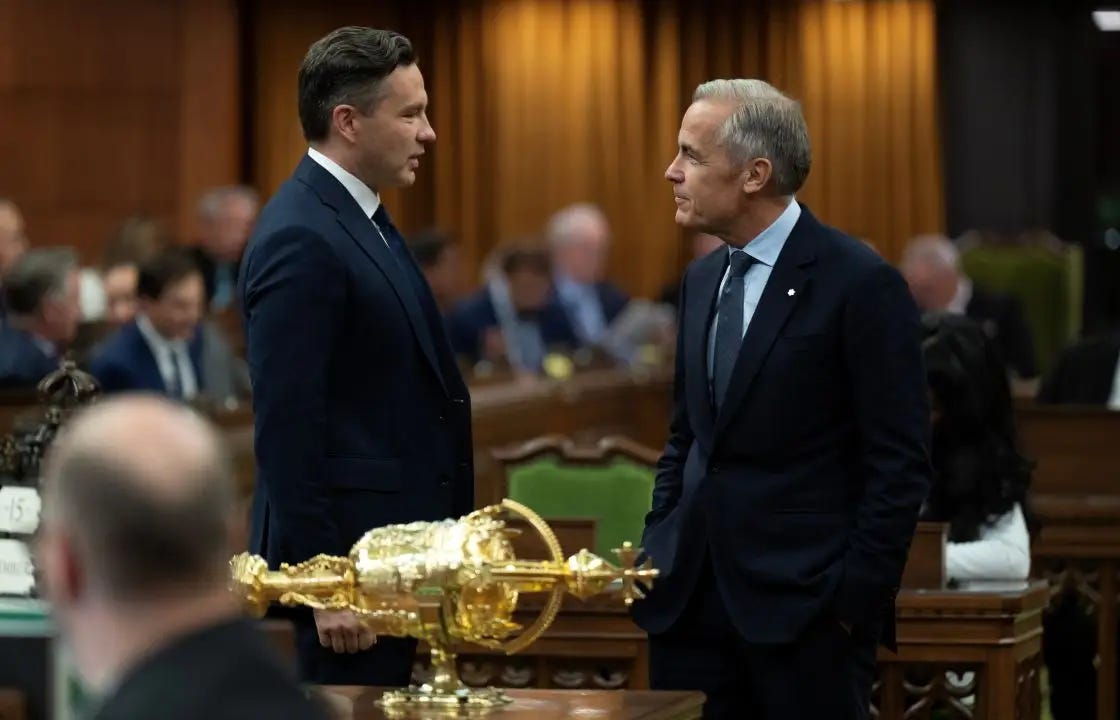
A year and a half ago, I developed a documentary web series with the support of the online magazine Canadian Affairs. I was to be the subject: a recent Canadian immigrant who had, as the logline put it, “fled a country torn by political strife.” It was an overstatement, but only a slight one.
I was approaching my first Canadian election with no party loyalty and a commitment to learning the politics, issues, and history of my new country. My top issue would have seemed quaint, even naïve, to anyone still living through what I had left—don’t elect someone who will divide the people. The series was called Undecided Voter.
I was born in the United States, moved to Canada for graduate school in 2011, and became a dual citizen in 2023. Those intervening years were not good ones south of the border. From where I stood, both the political right and left had become extreme, even irrational, hell-bent on taking the country in different directions, neither of which the majority wanted.
Canada felt different. I arrived during the final years of Stephen Harper’s Conservative government and watched the campaign that brought Justin Trudeau to power. It was by no means a lovefest, but it was a political culture where “loyal opposition” seemed to be taken literally. The runners up questioned and pushed the party in power. They didn’t claim they lacked legitimacy.
Over Trudeau’s years as Prime Minister, things began changing. “F🍁ck Trudeau” yard signs and bumper stickers pained me, not because I had an allegiance to the Liberal Party, but because it revealed the opposite of what I thought of as the Canadian character. In many ways, it felt just like the backlash against Obama, a cultural spillover from my homeland to the south.
But the candidates running against him didn’t take the bait. During the 2019 campaign, the crowd at a rally for Conservative candidate Andrew Scheer began chanting “Lock him up! Lock him up!” Scheer quickly changed the chant to “Vote him out! Vote him out!”
Then in 2021, after Trudeau called a “snap election” that could fairly be described as an opportunistic power grab, the Conservatives did something unthinkable in the US, they nominated a true centrist, Erin O’Toole. He also lost to Trudeau. Nevertheless, his final speech in Parliament was conciliatory, “I see unfair and wild language branding Justin Trudeau a ‘traitor’ for some of his actions,” he said, “These claims are ridiculous.”
I wasn’t a voter then, but I would have voted for O’Toole. He struck me as a chance to interrupt the cycle—a candidate who might restore a measure of equilibrium. My liberal Canadian friends reacted to him with a derision not dissimilar to American liberals’ feelings for Trump.
After O’Toole’s defeat, Pierre Poilievre, a more overtly populist figure, won the Conservative Party leadership in a landslide. His platform was in the Reagan tradition, but populism is not about a policy program. It is a posture: the corrupt elite has captured power and governs in its own interest; the people are its victims.
The next election was slated for 2025. Both candidates felt divisive to me: in the case of Poilievre, division as strategy; in the case of Trudeau, division through character—his blind spots reflected a man who believed that his values were everyone’s values.
An American immigrant, recently naturalized, genuinely curious, looking for a leader who wouldn’t divide his adopted country—this felt like a story worth telling. In a country with so many recent immigrants navigating their first vote, it felt like it might be useful, too.
However, a week after Canadian Affairs committed to Undecided Voter, Trudeau’s government began to unravel. At risk of losing the parliamentary support required to govern, he resigned and his party selected a new leader to face Poilievre.
That leader was Mark Carney.
Carney appears to have been designed for me. He is a remarkably intelligent centrist with a record of exceptional competence, most notably during the 2008 financial crisis. His book, Value(s) takes as a baseline that capitalism is the only economic system that has produced sustained broad-based prosperity, acknowledges its failures, and offers a blueprint of how it can become a better version of itself. Call my politics niche, but this is precisely what I want in a government leader.
I was no longer an undecided voter and, at that point, I dropped the project.
Carney’s candidacy immediately altered the trajectory of the election. With an assist from Donald Trump’s “51st state” rhetoric—which Poilievre had no idea how to react to—he led a party that had been trailing by 26 points under Trudeau to a comfortable victory.
A year and a half later, Carney’s approval ratings are very strong. Through wins in by-elections and defections from other parties, he has deftly secured a majority government. He delivered a speech-heard-round-the-world in Davos that cast him as a spokesperson for the countries that are wealthy enough to matter, but not powerful enough to dictate terms.
By any conventional measure, the candidate “designed for me” is succeeding.
But being on the winning side is when questioning disappears. I watched Democrats fall into complacency in 2016. Carney appears designed for voters like me, but that hardly meant that he could sustainably unite the country.