

A Way to Drink Less

It’s not easy to accept that you drink too much. One challenge is that when you start considering it, almost all of the advice out there will point you to abstinence.
But I don’t want to stop drinking. Drinking can be a ton of fun; it can relieve stress; it acts as social glue.
Hangovers are real, though. I wasted too many days. And early death is real, too. As I got older, the early death thing started to resonate.
My problem as a drinker was that my body had a switch that got flipped when I had a few drinks. Or even just one. I got a surge of adrenaline, and my hand-to-mouth impulse was triggered. My body started sending a signal to my hands: drink faster! Google will tell you that this is a sign of alcoholism, and I don’t doubt it. “Inability to control drinking” is the medical terminology—but I wasn’t convinced that I was unable to control it. I wasn’t ready to accept that it was insurmountable.
I’m happy to share that I found a solution that worked for me. It’s a free app called DrinkControl.
DrinkControl is exceptionally simple. You enter in drinks as you have them. The home screen tells you how many drinks you have had that day, how many drinks you have had over the past week, and how many drinks you have had over the past 30 days. Alongside each of these numbers is the National Health Service’s recommended limits (two drinks in a day, 14 in a week, and 60 in a month). If you like, you can also track the calories and dollar cost you accumulate drinking.
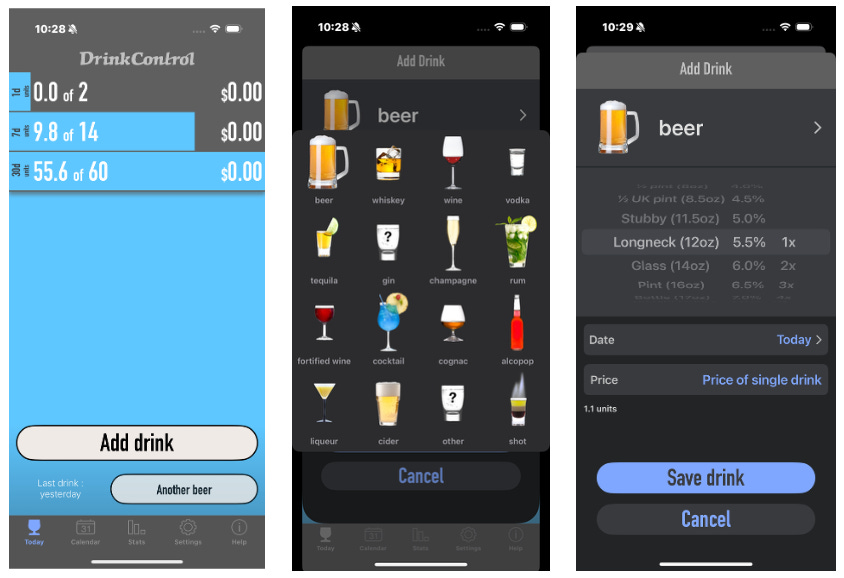
I’ve been doing this for close to seven years. That’s right, every time I have had a drink since October 4, 2019, I have recorded it. It’s work, and it can make every drink you have a tiny bit of a downer. If you can answer the question “Do I have a problem with my drinking?” with a definitive “No,” then it’s not for you.
Nor is it a solution for someone whose life is being wrecked by their addiction. But for someone who is trying to drink less and struggling to do so, it really works. I don’t know exactly how much DrinkControl has cut back on my drinking because the act of measuring immediately results in less drinking. I’d guess that I cut down my drinking by ¼ the very day I started. Measuring the past twelve months against the first full year that I recorded, I’ve cut back by another 50%.
Before I started doing this, my doctor asked me how many drinks I had in a week. I did what I thought was conservative math in my head, and she grimaced. Then she added, “Everyone underestimates.” She was right. 60 drinks in a month may seem like a lot, but take, for example, a pint of IPA; that’s not a drink. That’s 1.8 drinks.
It’s worth repeating: everyone underestimates.
The formal mechanism of DrinkControl is measurement. What really makes it work, though, is gamification. When I start seeing my drink totals going down, I feel like I’m winning the game and I’m happy with myself. Gamification keeps the whole thing from being as tedious as it probably sounds.
One hazard: the mind loves winning so much that it will try to cheat. My gut wants to underestimate the size of a drink or its alcohol-by-volume. I never give myself the benefit of the doubt in situations where I’m not sure. For DrinkControl to work, you not only need the willpower to use the app every time, you also have to be your own referee.
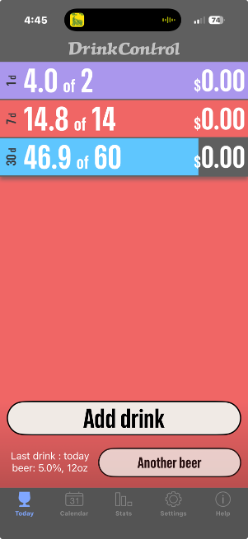
Over time, I’ve found edge cases where I can cut back. I seek out 12 oz cans at the grocery store in lieu of the more common 16 oz. I check alcohol percentages before buying. I cut out day drinking. I certainly don’t do shots. I often don’t finish a bottle of wine or my last beer. Who leaves a quarter of a beer on a table, especially if they’re not driving? I do. It adds up.
Tracking drinks helps you see your own patterns and adapt to them. If I can wait 15 minutes after a first drink, perhaps by having a sparkling water or a non-alcoholic beer, the urge will be gone before I finish it. I love bourbon but I saw that it correlated strongly with my heaviest drinking nights. Now I only drink whiskey mindfully—which is to say that I give all of my attention to the experience when I drink whiskey. It’s more delicious than ever.
I never get plastered anymore. I mean, I’m pretty old, and I shouldn’t be getting plastered anyway, but again, I’m admitting that I had a problem. Finally and most beneficially, I recognized how much a long active day decreased my desire for an evening drink. I spend more time outdoors and in motion now. Talk about a healthy trade-off.
Diets that stick allow exceptions, and I have learned when it’s worth it to let my numbers go up. I’ve already mentioned the bourbon. I also adore Trappist ales, and they are two or more times as strong as normal beer. I still treat myself to them.
And then there is the social factor. There’s a lot to be said for getting to know Dave from IT at happy hour. We’re happier when the people we work with feel like humans. When I meet with friends I haven’t seen in a while, I’m probably going to get a bit drunk, laugh a lot, and have the sort of unguarded conversations that help build meaningful friendships.
So here I am, close to seven years in, and I feel great. I’m sharper; I get more accomplished; I have less guilt; I’ve lost weight; and I enjoy the drinks that I have more than ever. I do miss the out-of-control nights, but not as much as I enjoy the days feeling 100%.
Happy moderate drinking!
Amen my friend!