

Cinema with Teeth

The first essay that I posted on the Internet was “My Year in Film 2015.” It became a series, now eleven years running.
For the first ten years, I made a point of judging movies entirely by what I saw between the opening credits and the closing credits. Whatever was happening outside the frame was not my readers’ problem.
Shortly after I began writing, a new quasi-requirement started dominating arts discourse: every work needed to be subjected to a political critique. My seemingly intuitive act of focusing on the film itself increasingly felt like a form of dissent—my little way of standing up for art as something valuable in itself.
Recently, though, I began to believe that the forces I had been shunning were shaping the films themselves. It felt neglectful not to address them. My Year in Film 2025 broadened the lens.
I have a larger audience on Substack today than I had on Medium six months ago, so I’m posting an abbreviated version of the essay here focused on my argument.
The film industry has fixable problems, and I want to talk about them. Plus, there are still amazing movies being made that I want people to know about. These films are the reason I remain optimistic about cinema—and the reason I keep writing about it.
My Year in Film 2025
At least three pressures are shaping contemporary filmmaking today.
First is economic pressure. The business of Hollywood is what it is, but I’ll make the case that it is getting worse. The peculiar economy in which independent American film operates has never been more hostile to risk. A handful of distributors and streamers bet on independent films, and when they do, the bets are large relative to the budgets. But collectively, those bets are placed on fewer than a dozen indies each year. Hundreds, even thousands more, compete for financial scraps.
Second, ideology has become almost as much a part of the industry as economics. If a filmmaker raises a question, there is a correct predetermined answer, and he or she is expected to provide it.
A third and perhaps the most difficult pressure may be the audience itself. Reductive algorithmic segmentation, coupled with auto-queuing, has achieved its end goal. The audience is on soma. Its appetite for challenge, long waning, has collapsed.
The incentives for filmmakers to soften edges or broaden appeal are obvious. But no one chooses filmmaking as a career based on a cost-benefit analysis.
The one question that truly matters: what has all of this done to the work itself?
Many movies I saw in 2025 suffered from the same instincts: a retreat from ambiguity, a reluctance to take audiences to unfamiliar ground, fake provocation.
The films that stayed with me resisted those impulses. They trusted the audience; they allowed contradiction and even discomfort.
The films I write about are the ones that surprised me—the ones I argued about and kept turning over in my head. Taken together, they show us where cinema still has teeth—and where it’s quietly filing them down.
My Favorite Scripted Films of 2025
Magellan
One Battle After Another
Sirāt
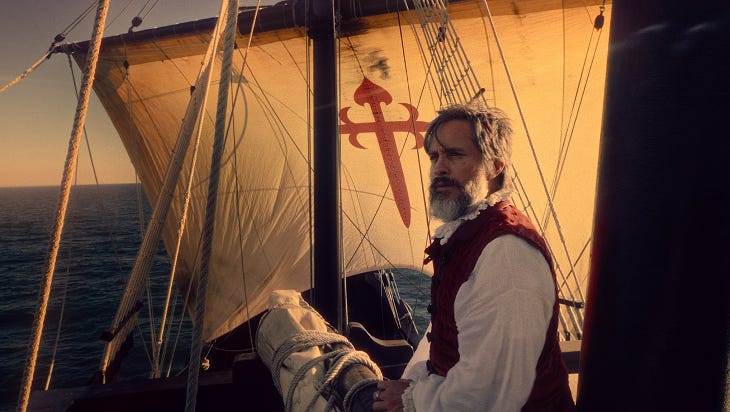
Magellan
There are twenty or thirty directors whose every film premieres at one of the major European film festivals. In that artsy-ass cohort, Lav Diaz is the artsy-assiest of all. With Magellan, I’m happy to report, he has made his first reasonably accessible feature film.
In 2015, the idea that all art is political was a dorm room debate. Now it is an unchallenged orthodoxy. That shift drains art’s lifeblood. When work is framed primarily as ideological expression, artists feel pressure to signal alignment rather than explore complex realities. Nuance and interiority give way to messaging.
Diaz is an artist whose natural voice is built on political conviction. His films are all political, but he doesn’t moralize. I am not opposed to political cinema. What I am opposed to is cinema that mistakes political certainty for political seriousness. Diaz makes great art because he floats over dogmatism and creates agenda-driven films that still stimulate the mind and move the soul.
If I were building a free-thinking young radical from scratch, I’d start by pairing Magellan with my favorite film of 2024, Soundtrack to a Coup d’état.
The two films operate in almost perfect opposition. Diaz recreates the early 16th century; Soundtrack assembles the mid-20th from archival fragments. The former lulls; the latter bludgeons. The former withholds comment; the latter instructs—at times literally, with on-screen footnotes.
We’ve heard so much about colonialism lately—and often in such a condescending tone—that it’s easy to understand why many people tune out when the subject appears again. But the history is real and enormous. When filmmakers approach it not with moral theater, but with open-minded engagement, the results can be extraordinary.
One Battle After Another
One Battle After Another is a fun-house mirror: it exaggerated our present moment without claiming to decode it. Its political texture exposed a tedious modern critical reflex: the urge to position every movie as red or blue.
Manohla Dargis called One Battle After Another a “rallying cry” for the left, while Bret Easton Ellis observed “a liberal mustiness to this movie that already feels very dated by October 2025.” Both readings treat the movie as propaganda, collapsing it into binaries that, in reality, the movie is satirizing.
One Battle is adapted from Thomas Pynchon’s Vineland, and writer-director Paul Thomas Anderson understands the author’s method. Pynchon’s satire interrogates power whether it is governmental, corporate, cultural, or radical, and he expands his critique until it implicates everyone.
I’m not blind: One Battle reviles the militant right while its left-wing radical protagonists are treated with affection. But if Anderson was trying to make a rallying cry, why are his protagonists hopelessly dysfunctional, completely impotent, even treacherous?
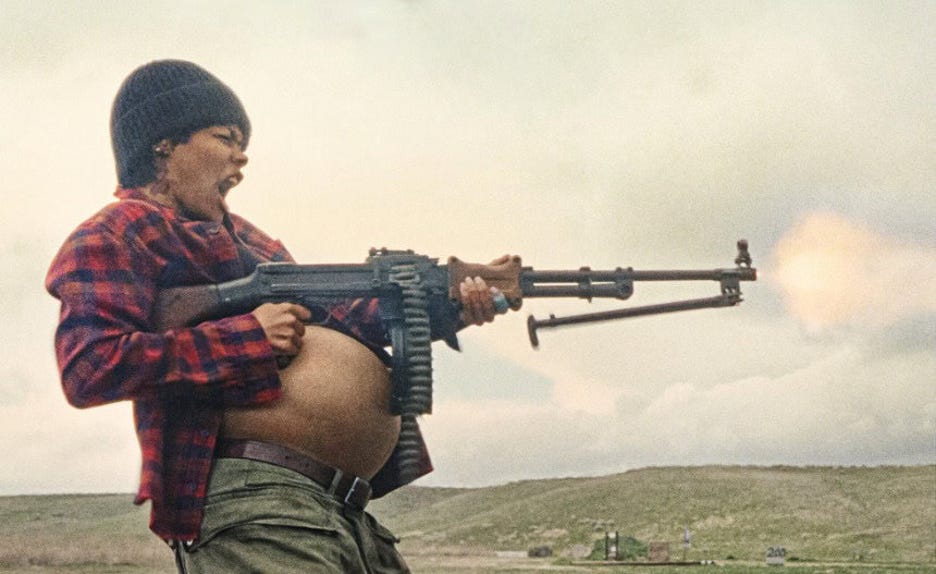
The image of Perfidia Beverly Hills firing an assault rifle buttressed just above her heavily pregnant belly was designed for instant iconicity, but it carries a calculated cognitive dissonance: it demands the audience’s awe while simultaneously triggering a reflexive, sickening realization that “this can’t be good for the baby.”
On the other side, Bret Easton Ellis’s take aged like milk. One Battle After Another can’t have been “very dated” in October 2025, when in December 2025, images out of Minneapolis—warrantless raids, civilian shootings, the abandonment of due process—fulfilled the film’s caricatures.
Director Paul Thomas Anderson was asked about his film’s prescience after a promotional screening.
I can’t say it feels great and I can’t say that it makes me happy. It just makes me feel peculiar. It’s just supposed to be an action movie about a guy trying to get his daughter back. And, what I see every day, it weighs heavy on my heart for the world. It was nice to come into the back of the theater and sneak in and watch everybody laughing and enjoying it. Actually, that warmed me up. It’s supposed to be funny and entertain you and have fun, but it’s a fucking trip to see those Christmas Adventurers talk the way they talk, and I don’t know, it seems there’s got to be a room like that somewhere right now. Dudes talking like that.
My favorite performance of 2025 was Sean Penn’s Colonel Stephen J. Lockjaw, who aspired to be one of the Christmas Adventurers. In this character, Anderson and Penn created a new archetype. Lockjaw is the rot of the soul manifesting in the body. Lockjaw is danger that is ridiculous, but real. He is pursuing false redemption when real redemption is there for the taking. Like the rest of the movie, he sits just a little over the line of credibility.
At least it felt that way back in October 2025.
Sirāt
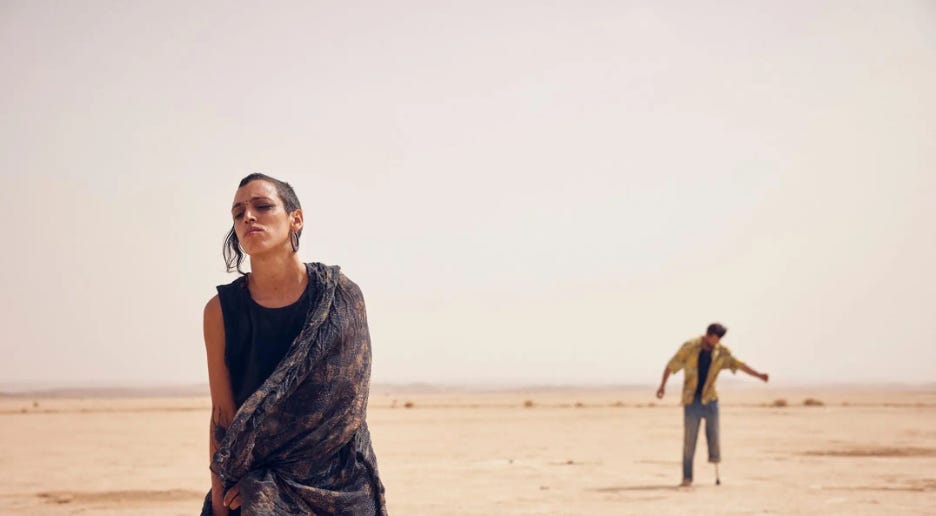
The Internet defines “pure cinema” as “filmmaking that prioritizes visual storytelling over dialogue, plot, or literary devices.” From this viewpoint, Sirāt is undoubtedly my movie of the year. Its ethereal desert landscapes, interspersed with inside-the-throng dance sequences, earn it my Favorite Cinematography of the Year. Its pummeling tribal techno is hands down my Favorite Score of the Year.
Stunningly, the score was nominated for an Oscar. I long ago stopped worrying about obscure and difficult films getting snubbed by the Academy. The fact that Sirāt received this recognition shows that we’re talking about something undeniable.
But I am not recommending this movie. If you genuinely appreciate being challenged by art, you must see Sirāt. In a theater if you can, but at a minimum, on a big flat screen with your devices off and the pause button out of reach.
[THERE ARE SPOILERS FOR SIRĀT UNTIL THE NEXT SECTION]
Modern audiences are difficult to shock. Decades of escalating spectacle and horror have conditioned viewers to expect the extreme, which means that when a film delivers a jolting moment, the audience is usually prepared. A classic exception is Psycho. Alfred Hitchcock upended audiences’ expectations in a way that still feels audacious.
Like Hitchcock, Sirāt director Oliver Laxe delivers a moment of such abrupt intensity that it feels genuinely destabilizing. In a culture largely inured to cinematic provocation, it accomplishes something rare.
And yet I’m not entirely sure it earns it.
I know two people who were deeply upset by the film—angry as well as shaken, moved in a way that felt unpleasant rather than cathartic. My own reaction was different. I admired the sheer force of the moment. It achieved something I hadn’t experienced before in a theater.
What kind of narrative runway should precede a moment that extreme? Most films operate under an implicit contract with the audience: if they’re going to cross a certain emotional line, they first prepare you for it. Sirāt’s shocking moment lands like an assault. Its power is inseparable from the surprise—not just because of Laxe’s calculation, but because it feels like real life in the scariest possible way. In reality, that which we love most can be taken from us at any moment.
I loved the movie, but I don’t want to steer someone toward an experience they might genuinely hate. At the same time, warning them would dull the very thing that makes the scene so powerful. Does anyone besides me actually skip spoiler sections?
Sirāt really tests my usage of “favorite” rather than “best” in these essays. Is it better than Magellan and One Battle After Another? I think so, yes. Was it my favorite scripted movie of the year?
[contemplates for 20 minutes]
Yes.
A Movie that Deserved Better
Magellan demonstrates that political filmmaking does not require ideological coercion. Luca Guadagnino’s After the Hunt goes further, refusing to provide the politically correct answers to radioactive questions.
After the Hunt is the kind of highly crafted, character-driven button-pusher Hollywood made in the 1970s. It is impeccably acted by major stars and Guadagnino is one of the few serious filmmakers with commercial clout. It would seem to be exactly the sort of film critics claim to want.
And yet it sits at 37% on Rotten Tomatoes—that was enough that I kept away.
On Friday, though, I read Alec Mouhigian in Compact Magazine, arguing that the film was effectively blackballed for being “the first major motion picture to explicitly name and confront the evil of MeToo.” Caustic words.
The plot turns on a ‘he said/she said’ assault accusation involving a young queer Black woman whose identity adds layers the film refuses to resolve. It’s a lightning rod of a topic, but the film handles it with a striking even-handedness. By my take, After the Hunt could serve as a perfect entry point for good-faith debate. Julia Roberts, Ayo Edebiri, and Andrew Garfield—all publicly liberal—clearly felt comfortable standing behind it. And yet there it sits at 37%.
Over the past two years, corporate pressure, changes in ownership, and political fatigue have nudged Hollywood rightward. The question is whether certain lines remain uncrossable. I think they do, but in a more specific way than Mouhigian suggests.
As every single critic noted, the film opens with a credit sequence identical to the one Woody Allen has used for 50 years. I suspect that this was intended as a wink, but landed as a signal. Allen remains quietly admired and very vocally reviled. I believe that invoking him without comment read as taking his side. More than the film itself, I think that the credit sequence was a bridge too far. Rather than delivering a knowing wink, Guadagnino triggered tacit permission to treat the film as something of a faux pas that should be quietly swept aside.
The film’s very existence suggests an appetite—even within Hollywood—to revisit the mixed legacy of MeToo, a culture-altering phenomenon birthed within their own house. Maybe the Allen gesture squandered that opportunity. Or maybe we still aren’t ready to look at that reckoning outside a hyper-partisan frame.
Whatever the case, the end result is that no one will be putting $80 million into a film like this ever again.
Given the film’s status as a non-event, you likely are unaware of the one point of consensus about the film: the performances. Ayo Edebiri is fearless. You can see the thoughts her character is trying to hide. Andrew Garfield moves fluidly between charm and deviousness, holding both in tension, before finally coming undone. Julia Roberts reveals a register I didn’t know she possessed. She went for a second Oscar and her performance delivered, even if the ecosystem did not. And then there’s Michael Stuhlbarg, who continues to quietly build one of the most formidable acting careers of the 21st century. In most films, his cuckolded husband would be either forgettable or a caricature. I would happily watch an entire film built around the character he plays here.
No one is miscast; no one is coasting. Each performance sharpens the film’s central contradiction between cruelty and vulnerability. It was My Favorite Ensemble of the Year.
[Post-script: Guadagnino’s new film, Artificial, about the rise of the AI titan OpenAI was dropped by Amazon MGM Studios several days after Amazon had signed a $50-billion deal with OpenAI.]
My Favorite Documentaries of 2025
André Is an Idiot
André Ricciardi could have been famous. He was intelligent, perceptive, very funny, and a natural born iconoclast. Looking back on his life, he isn’t thrilled that his talents were expended on the advertising industry. The one thing that really sticks in his craw, though, the thing that so clearly makes him an “idiot,” was that he waited until he was 53 to get a colonoscopy. It was too late to save his life, but not too late to make an impact.
If there is only one movie from 2025 that I can recommend to any viewer, it is the hilarious, heartbreaking, and inspiring public service announcement that is André is an Idiot. Rarely has mortality been rendered with such buoyancy.
While the Green Grass Grows: A Diary in Seven Parts
Filmed over three years and bookended by the deaths of his mother and father, Peter Mettler’s While the Green Grass Grows is a memoir that drifts between bereavement, family history, travelogue, stream-of-consciousness reflection, and psychedelic reverie. Watching Mettler’s movies is like borrowing his eyes for a while. He sees things others miss; he shares his patience.
Billy Joel: And So It Goes
Sometimes ambition in filmmaking means pushing form to its limits. But sometimes it means the opposite: recognizing that the subject itself is large enough. A special life told with quality, unassuming craftsmanship is formidable on its own terms. Enlarging the subject into a vessel for broader social arguments or anything that draws attention to filmmaking distracts from the main course: a fascinating life.
The biodocumentaries that transcend into art often do so, improbably enough, through duration. Long runtimes allow us to take in something resembling the breadth and impact of a life. Any list of the best biodocs of this century must include The Zen Diaries of Garry Shandling, George Harrison: Living in the Material World, OJ: Made in America, and Mr. McMahon, films with runtimes ranging from 208 to 467 minutes.
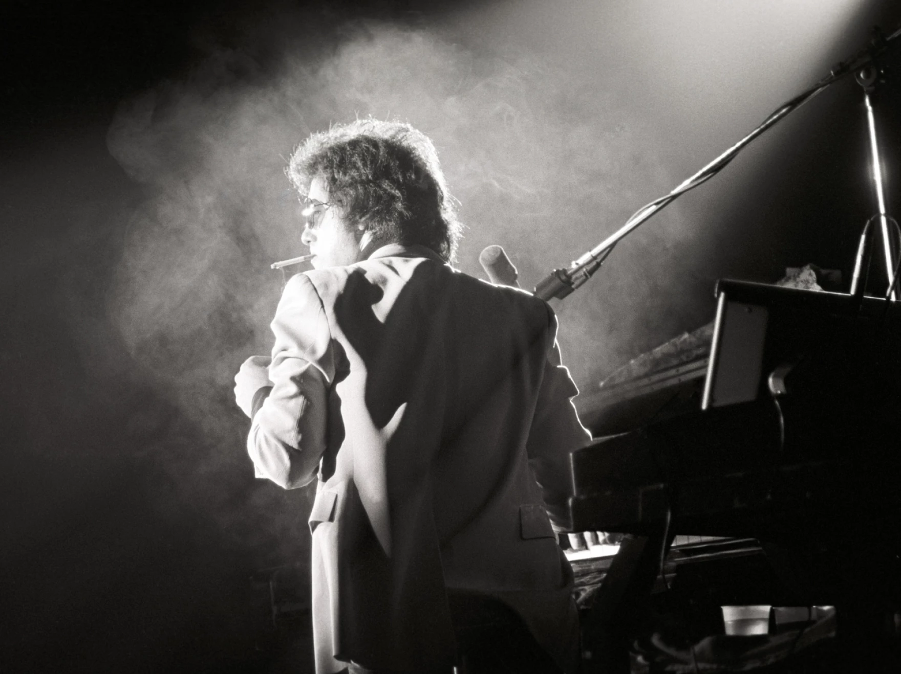
When the subject earns it, duration is not indulgence; it is perspective. The 288-minute Billy Joel: And So It Goes is a new addition to this secret canon.
Joel is something we seem to have been wholly missing for at least 30 years: a salt-of-the-earth superstar. He neither self-promotes nor cultivates an air of mystery. He’s just this wildly talented guy from Long Island.
From his broken childhood family through his guitar-less metal band Attila (!), through 33 hits and four wives, And So It Goes does not present Joel as someone to emulate. It presents Joel as a man who has lived life like it matters.
Pee-Wee as Himself
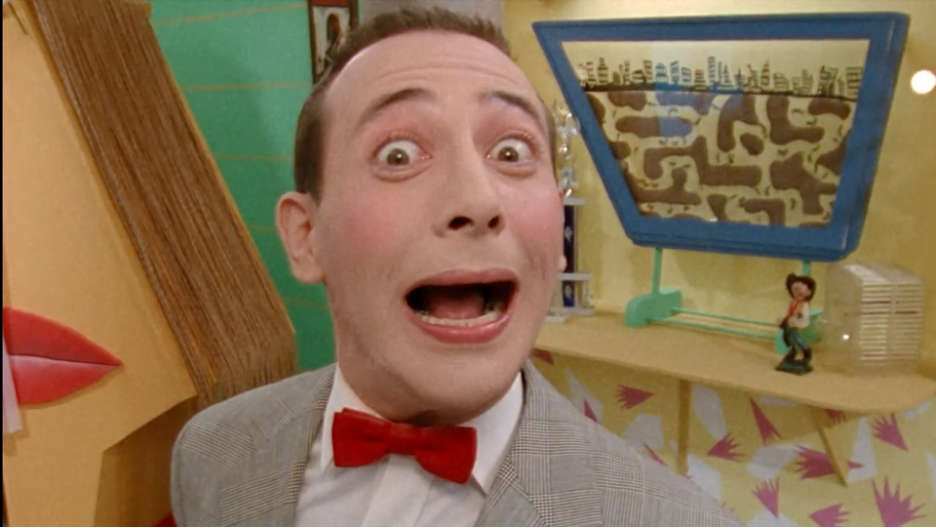
Pee-Wee as Himself is aptly titled. Paul Reubens was strategically anonymous and obsessively devoted to a single creation: the character he played, Pee-Wee Herman.
Making oneself part of the story is always a risk, especially when the director is unknown and the subject beloved. Matt Wolf pulls it off. His interactions with Reubens underline the themes already present in the story. Two of Reubens’ defining characteristics are his sense of life’s absurdity and his deep-seated need for control. The give-and-take rapport Wolf establishes draws out and underlines these contradictions.
Pee-Wee as Himself never loses contact with the character’s positivity and silliness. But at its core, it asks a serious question: what is great art worth? Is it worth sacrificing friendships? What about abandoning your life partner? Hiding yourself for decades?
The film’s melancholy passages make the case against Reubens’ sacrifices. But through his conviction, his accomplishment, and, most of all, by reminding the audience of our own love for Pee-Wee Herman, the film makes the counterpoint: great art is worth it all.
The Book of Prince
The films I loved most in 2025 countered the trends shaping the business. Magellan investigated political subject matter without ideological coercion. One Battle After Another is political satire that refuses binary interpretation. Sirāt ambushed audience expectations. After the Hunt was punished for the ambiguity that distinguished it. My favorite documentaries allowed their subjects to remain contradictory and fully human.
Now we break from what happened on screens in 2025 to what didn’t happen. Ezra Edelman’s The Book of Prince might have been my favorite film of the year if it was possible to see it.
Edelman is best known for OJ: Made in America, which would be the betting favorite for ‘best documentary of the century’ if such an award existed. With full access to “the Vault,” Prince’s legendary archive held in a safe at Paisley Park—his home and studio—Edelman and his team spent five years making a nine-hour movie: The Book of Prince.
The long bio-documentaries that I adore approach the totality of a person, and that includes a person’s contradictions. Prince made clear himself that he was not a saint. The power of great documentary is not that it reenforces a myth, but that it tests it. The coexistence of genius and cruelty, discipline and paranoia, otherworldliness and ego all belong in the film. True greatness calls for more than empty tribute.
Sometime during the years of The Book of Prince’s production, a music rights–exploitation company (yes, that’s a thing that exists, and yes, it is funded by Private Equity) bought a stake in Prince’s estate. The new corporate owners did not share Edelman’s trust in the audience and commitment to authenticity, and they deemed the film a threat to the long-term value of their new asset. Inexplicably, Netflix’s lawyers hadn’t contractually locked in the final-cut creative freedom that Edelman had been promised. The Book of Prince will not be released. The estate is now putting together their own film—with Netflix’s support.
Prince impacted me more than any other artist. For this to happen after one of the world’s best documentary teams spent five prime years of their careers making the definitive film version of his life felt like getting punched in the face.
I pray that someone leaks this movie to BitTorrent. If you, my reader, send me your email address, I will let you know how to get it when that happens.
More Bold Visions
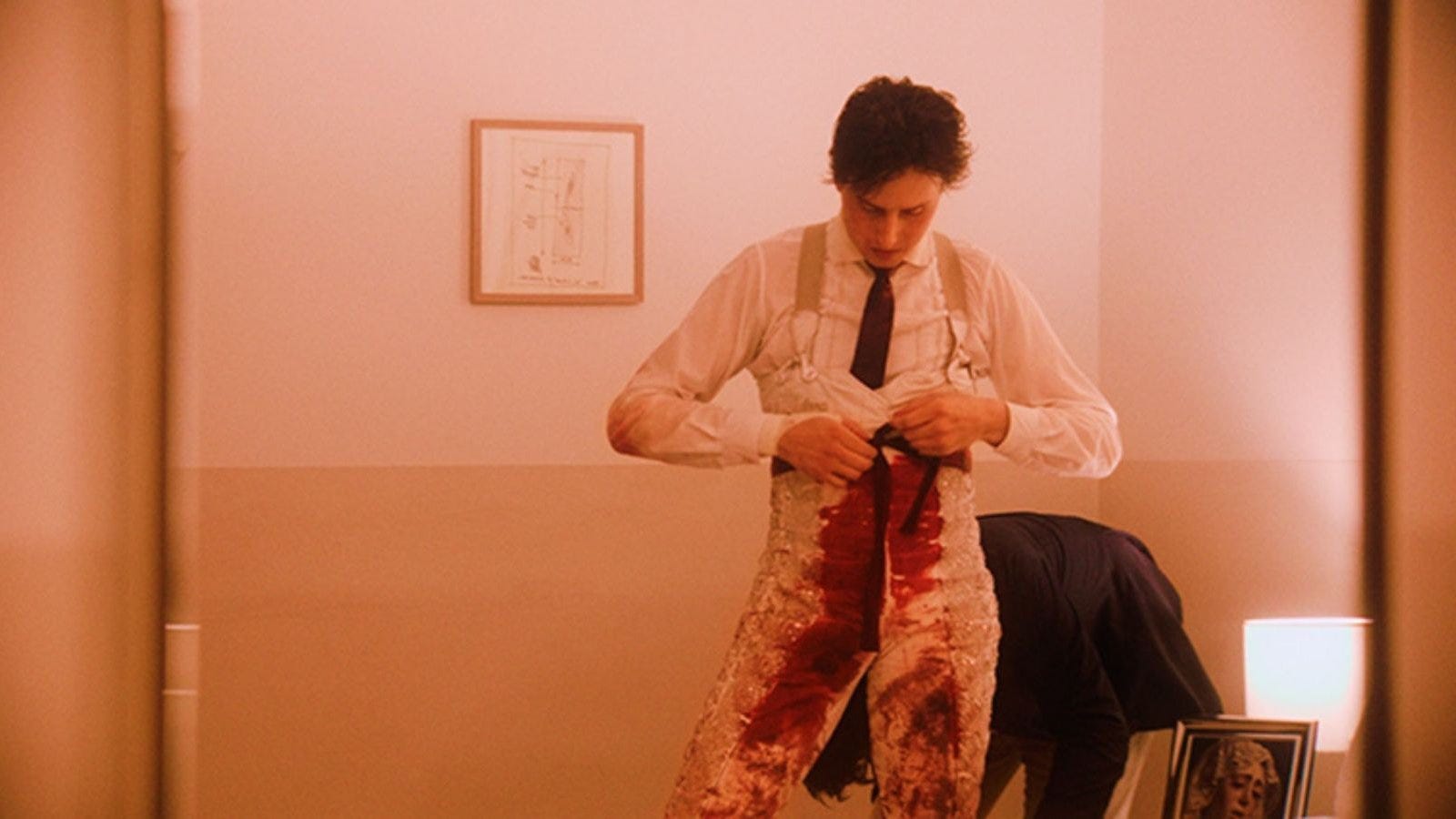
It’s possible that no movie has ever shown its audience one thing as well as Afternoons of Solitude shows us bullfighting.
The Age of Disclosure makes the case that aliens visit Earth frequently. The filmmakers take on the role of prosecutor. They bring many credible witnesses to the stand, but with no attempt to offer a counterpoint—and with overwrought music pushing their agenda—you don’t have a whole case, or a whole movie.
Eephus puts you inside the end of an era. As the world pushes forward, Eephus’s characters gaze backward—mostly. It is an elegy for the American Century, but an optimistic one.
Coming off her masterpiece Four Daughters, Tunisian director Kaouther Ben Hania again bends genres into previously unimagined forms with The Voice of Hind Rajab.
The Perfect Neighbor makes a singularly powerful case about a specific policy issue. My Favorite Editing of the Year.
Souleymane’s Story is an exciting new exemplar of “show, don’t tell.” It presents its immigrant’s story with honesty. By showing Souleymane manipulating the system, it avoids manipulating the audience. Its empathy is therefore earned.
You know that moment when you are in a movie theater and you get the addictive urge to check my phone during a slow moment? If you have turned your phone off, it’s amazing how quickly that feeling goes away. You realize you can’t check your phone that instant, and your attention goes back to the screen. There’s something about that little bit of forced discipline that I adore.
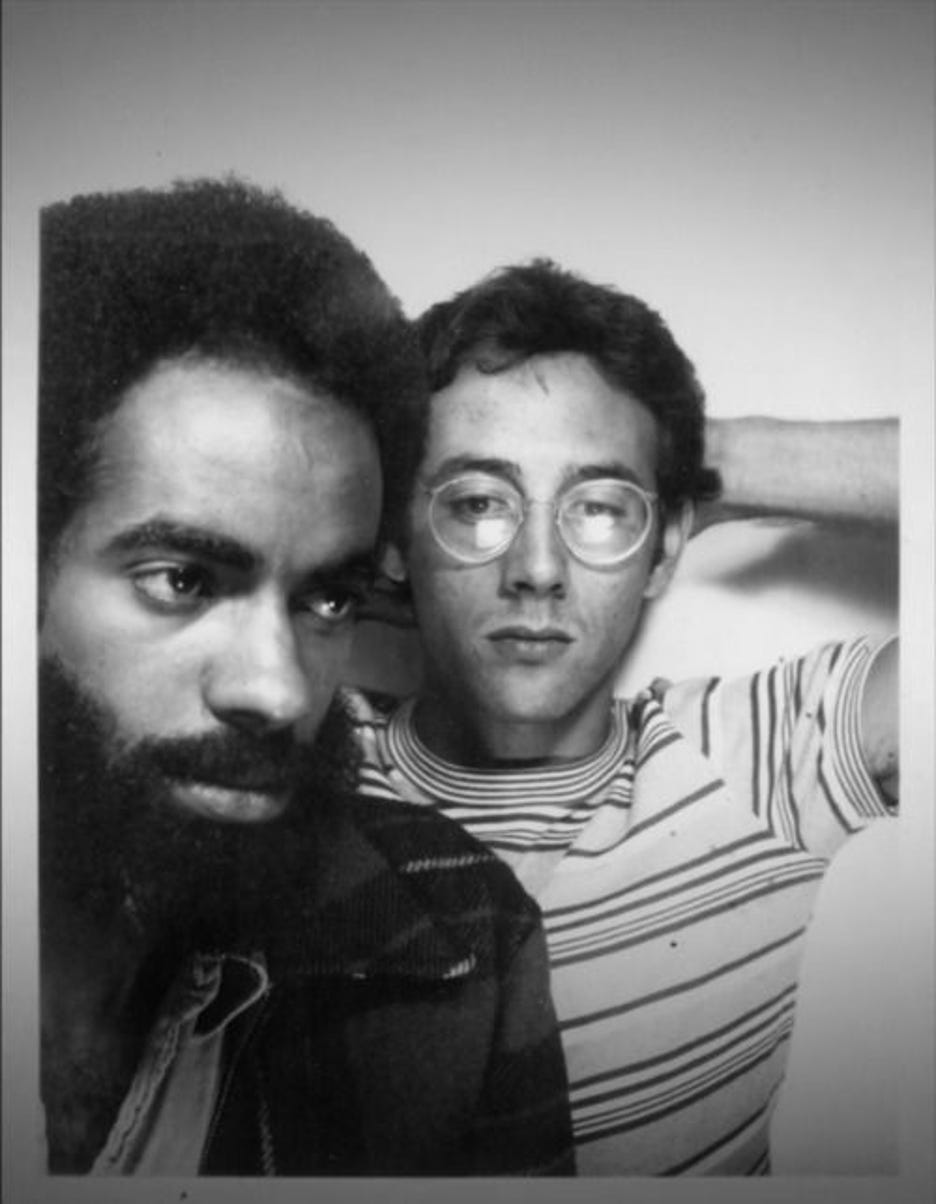
No movie has made me do this more times than Peter Hujar’s Day. Half the critics think this movie is genius and half think it’s the most mundane thing ever made. They might both be right. Let’s check back in 10 years.
Conclusion / Movies I Hated
Three forces are shaping the work that filmmakers are able to make: economics, political ideology, and audience conditioning. If my favorite films are notable for pushing back, these final films exemplify capitulation.
Being Eddie
I’m not naïve: movies are a business.
The history of cinema is defined by the perpetual tug-of-war between the visionary and the ledger. In the late ‘50s, the French New Wave rejected the studio-controlled “Tradition of Quality.” Their innovations blew people’s minds while simultaneously making them feel like anyone could make a movie. In the ‘70s, Cassavetes and Coppola bypassed the system entirely to self-finance films that became classics.
This isn’t a system that needs to be burned to the foundations. For a very long time, the balancing act has more or less worked. Now, though, the influence of the artist feels weaker than it has in a very long time. I hope, however, that this essay has shown great things can still happen in cinema. Surrendering is still a choice.
Which brings us to Eddie Murphy.
From roughly 1981 to 1988, Eddie Murphy was more popular than any comedian before or since. When his career shifted toward family films, it was an unexpected but reasonable second act. No one could maintain that kind of mass appeal or such genuine bite, much less both at the same time.
But in a 2019 episode of Comedians in Cars Getting Coffee, Murphy gestured toward a revitalized ambition. He said that he wanted to return to the site of his meteoric rise and host Saturday Night Live, and he promised a return to stand-up comedy.
Instead, he has made Coming 2 America, Beverly Hills Cop 2 and, I shit you not, eight Shrek projects.
But whatever. It’s hardly new for artists whose talents have faded to milk the sequel teat rather than take a risk. What galls me about the Netflix documentary Being Eddie is that in order to maintain the mundane, palatable Murphy of today, they neutered the past that is the root of his fame.
Did I expect the movie to address disputes over child support with former partners? I did not, but giving us 15 minutes of kumbaya with his four youngest children without even mentioning that there are six others off the screen is simply dishonest.
Did I expect Being Eddie to contrast the explicit homophobia of his early comedy with the fact that years later police found him with a trans sex worker? Not really, but in light of social progress on these issues, there was potential for something thought-provoking here.
But who had something to gain from provoking thought? Not Murphy or Netflix. The two parties are currently in negotiations for a contract rumored to be in the $70M range.
The ledger wins again.
Orwell: 2 + 2 = 5
Where economics pushes films toward banality, ideology pushes them toward certainty.
Raoul Peck’s Orwell: 2 + 2 = 5 is billed as the “ultimate and comprehensive documentary” on George Orwell, one of the most important political writers of the twentieth century. Watching it, you would never know that Orwell’s two ubiquitous classics, Animal Farm and Nineteen Eighty-Four, are critiques of the left from which he came. 2 + 2 = 5 addresses ‘newspeak’ and ‘thoughtcrime’ solely as right-wing exports, ignoring the lexicon used to signal in- and out-group status on the left.
Like Pynchon, Orwell trained his critique on power wherever he found it. Of course, he would be aghast by Trump and Hegseth. But Peck goes much further, shaping Orwell into a figure whose worldview mirrors his own. The result is not a biography and certainly not an exploration of ideas. It is a kind of ideological ventriloquism: Orwell speaking with Raoul Peck’s voice.
The tone of the film makes the problem worse. There is no call to arms, no “this is how we change things.” What you get here is a two-hour collage of contemporary geopolitical anxiety. It amounts to misery porn. Peck sees Orwell as the ultimate pessimist, and the dire state of the world today a vindication of that pessimism.
I dislike movies that tell the audience what to think. But when a documentary claims to present the definitive portrait of a thinker as serious as Orwell while reducing his work to a set of convenient contemporary slogans, it is a kind of cultural vandalism.
Orwell spent his career warning about the corruption of language and thought. It is a strange tribute to turn him into an instrument of it.
Frankenstein
Economics and ideology determine what films are made. Audience conditioning creates a mold that can only be filled with the familiar, and what is familiar is increasingly false.
Over the past thirty years, Hollywood and its audience have been in a feedback loop that has resulted in a form of spectacle that doesn’t pretend to feel real. Lighting is flattened and actors’ faces are smoothed until they look like magazine covers. The physical texture of the world disappears beneath layers of digital polish. Action sequences are often entirely digital. The result is a kind of visual weightlessness that leaks into narrative. There is no longer a sense of unpredictability, no sense that central characters are in actual danger.
Cinema once worked very differently. Older films often used deep focus and wider frames that allowed the eye to wander across the image the way it does in life. Those images engaged the same perceptual instincts we use to navigate the real world.
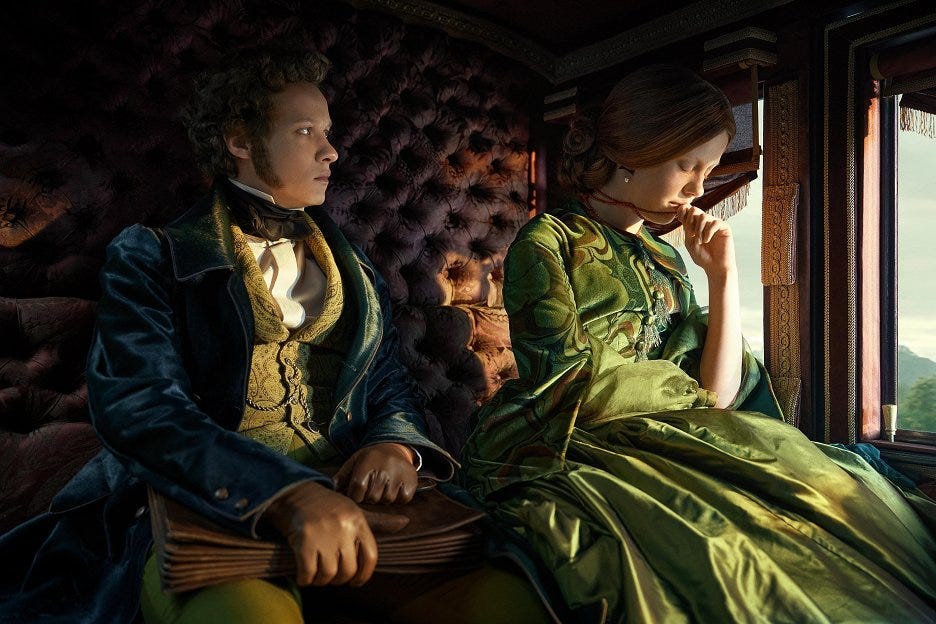
Guillermo del Toro is one of the cinema’s great enthusiasts — a filmmaker whose love of film history is obvious and contagious. Yet his Frankenstein embraces nearly every aesthetic habit that has homogenized modern spectacle.
Take the opening scene. A digital ship sits icebound in a digital wasteland. Soon, Frankenstein’s monster enters the scene, throwing haymakers at the sailors, each one digitally launching several men dozens of yards to inconsequential deaths (in a movie whose central theme is the preciousness of life).
At a later point, the monster is attacked by a pack of wolves. The problem is not simply that the effects look artificial, although they certainly do. It’s that they don’t behave like animals. They are generic modern action-movie antagonists, MacGuffins used not so much to move forward a plot, but to satisfy the audience’s expectation that enough time has passed since the last action sequence.
The monster, as played by Jacob Elordi, moves with elegant, choreographed grace. It’s a technically impressive performance, but it makes no sense; a being assembled from dead bodies somehow carries himself like he just graduated from Juilliard. Boris Karloff’s monster in Frankenstein (1931) felt uncanny precisely because his movements suggested a body that barely understood its own mechanics.
Spectacle works best when it feels real, and realism requires a sense that objects exist independently of the camera observing them. Film scholar Laura U. Marks has argued that the most powerful images in cinema are almost tactile, allowing the eye to function like an organ of touch. You feel humidity, grit, cold air, rough surfaces. Frankenstein aspires to the feeling of a video game, which is to say no feeling at all.
To add insult to injury, the film is widely expected to win the Oscar for Production Design. The Academy has honored bad work before, but it is rare to see a craft honored for accelerating its own decline.
***
The best films I saw this year pushed against the primacy of profit, the burden of ideology, and dulled audience expectations. Some did it through bold decisions in plot or aesthetics. Others did it through restraint, trusting that a life or a moment did not need embellishment. The underlying belief was the same. They trusted the audience to meet the movie halfway. In a moment when the culture expects so little of people and culture is engineered accordingly, that trust is not naïve. It is the most consequential thing an artist can offer.
If you liked this, there is quite a bit more in the original essay Marty Supreme, Eddington, Mountainhead, Sinners, Tim Robinson’s Friendship, Henry Fonda for President, Henry Johnson, Mile End Kicks, Nouvelle Vague, Put Your Soul on Your Hand and Walk, The Secret Agent, Weapons, and Zef: The Story of Die Antwoord were among the films cut out of this version of the essay.