

Obituary Music
Everybody's Everything; Juice WRLD: Into the Abyss; Look at Me: XXXTentacion

I used to love rap music. Back then, radio didn’t play it and there was no YouTube or Spotify. I found new rappers from Yo! MTV Raps, the Jukebox Channel, and from friends’ copied cassettes.
In this century, I learn about rappers from the New York Times. I learn about rappers when they die.
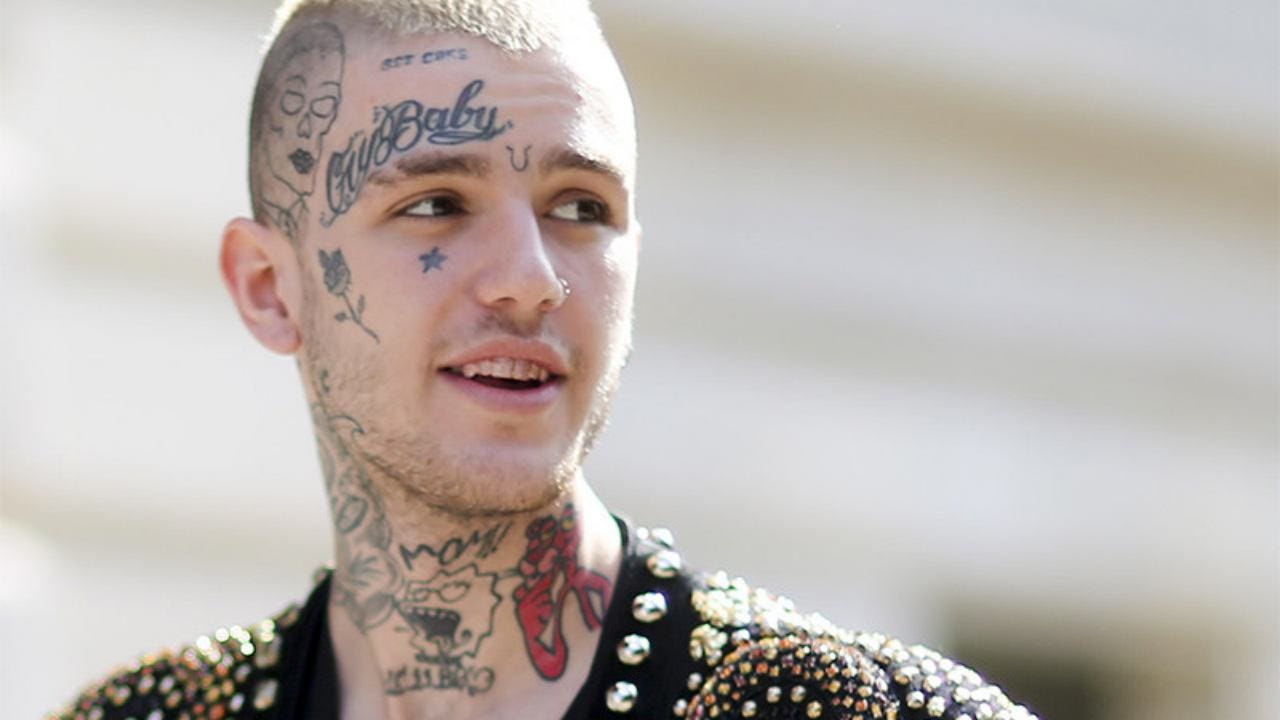
In November 2017, a barely twenty-one-year-old Lil Peep succumbed to a fentanyl overdose. His face was unlike anything I’d seen— almost translucently pale, covered in tattoos the way you’d cover a notebook in a study hall you hated. Facial tattoos have become stunningly common in the years since, but no one famous has surpassed that striking visage. Something about the contrast between the delicate features and the ink fixed itself in my imagination.
In June 2018, I learned of XXXTentacion (“X”) by reading that he was shot and killed in a robbery attempt. He was twenty. In December 2019—again. Juice WRLD collapsed in a seizure at O’Hare International Airport, also of a drug overdose, just a week after his twenty-first birthday. Peep, X, Juice: three deaths across twenty-five months, none of them older than they needed to be to buy a drink.
Everybody’s Everything (2019), Juice WRLD: Into the Abyss (2021), and Look at Me: XXXTentacion (2022) form an accidental trilogy—a portrait not just of three young men but of a generation, a sound, and a moment.
SoundCloud is a platform that allows anyone to share music without the label or studio infrastructure that recording once required. In the early 2010s, a loose constellation of teenagers—many from fractured families, few with any industry connections—began uploading tracks that sounded different from anything that had come before. The tone could swing from aggressive and chaotic to introspective and depressive, sometimes within the same song. They embraced alienation, anxiety, nihilism, and hedonism, often simultaneously. And they were naked about it. Where earlier hip-hop frequently built walls of bravado, these artists wore their damage as a kind of covenant with their listeners. I am this broken. Are you?
The response was enormous. These rappers’ YouTube streams numbered in the billions; their Spotify plays in the tens of billions. It’s peculiar that pop culture has a bigger footprint in our collective mind than ever before, yet entire cultural worlds remain invisible to most people. What the movies show is that charts don’t tell the story. These artists were the personal soundtrack for alienated kids alone in their rooms at two in the morning, finding in the music something they couldn’t find anywhere else.
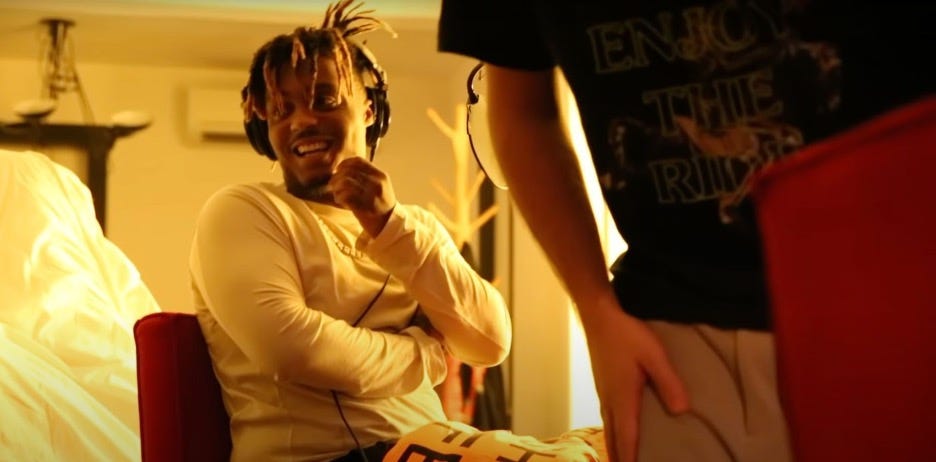
Into the Abyss follows Juice WRLD on tour, in studios, and just hanging out, which places it in an established lane for music documentaries—the lineage of Pennebaker’s Dont Look Back and the Lil Wayne film The Carter. This is a form with limitations. Without a clear narrative arc, it can feel shapeless, and mundanity is often the point. It works because you feel like you understand, from the inside, how these people actually live their lives—the hours, the entourage, the claustrophobia of the bus, the way that fame warps life, adding the extraordinary and the banal in equal measure.
Peep, Juice, and X all said that they expected to die young. They lived as if they believed it. Drugs fill the lyrics, and they consumed a lot of drugs on camera. In Into the Abyss, intoxication is nearly constant. They took the drugs of Gen Z: molly, weed, benzos like Xanax, and opiates. Percocet was practically a genre signifier. You can hear it in the pace of their beats and the drawl in their raps, in the looseness around the consonants. The drugs didn’t just accompany the music; they fueled it.
Everybody’s Everything is a more traditional bio-doc, and it benefits enormously from the archive its subject left behind. Gen Z had documented itself compulsively—phones always out, always rolling—and the footage accumulated around Lil Peep’s short life is rich enough to constitute something like a full portrait. The film’s heart is provided by Peep’s grandfather, John Womack Jr., a Harvard professor who reads aloud from the letters he wrote to his grandson throughout his life. The letters are wise, warm, searching—sending a lifeline toward this boy who was reaching toward everyone and no one. Everybody’s everything. We see Peep’s compulsive need to help other people, to absorb their pain, to bring them along with him, while understanding that the same impulse became a form of self-destruction.
These are not YouTube fan docs. Each movie had a real budget and each used it well. I recommend them without reservation. Look at Me: XXXTentacion is my favorite of the three because it has the most arresting subject. Musically, X was mind-blowing. His sonic range extends from highly distorted trap to acoustic folk to punk to pop. And he created so much so quickly, like he needed to empty his head to survive.
Look at Me is segmented with interstitial titles that keep pulling you up short: his age. X was fifteen when he did this; sixteen when he released that; twenty when he was killed.
Peep, Juice, and X all spoke, at length and in their music, about growing up without a father. X had an exceptionally difficult childhood. “You ever seen somebody get raped?,” he asked in a surreptitiously recorded conversation, “You ever seen somebody try to kill your mom in front of you?”
There is no shortage of great artists who are cruel. What X became, though, can genuinely be described as monstrous. He got into fistfights, attacked unsuspecting men, and live streamed the beatings. He served time in juvenile detention three times. Once, just days after being released, he led a home invasion during which he pistol-whipped a man three times before running off with electronics and twenty dollars.
On the same tape, X admitted to stabbing eight people in a street fight that police investigated but for which he never became a suspect. He invaded a second home—that of a musical collaborator—robbed him and stabbed him so severely that he needed major surgery to save his life. He viciously beat his girlfriend and was awaiting charges on false imprisonment and aggravated battery of a pregnant woman. “That girl is scared for her life,” he said, “Which I understand. She’s seen this shit. She know.”
The film was made in cooperation with X’s mother, and while it doesn’t look fully away, it doesn’t convey the extent of his psychopathy. It does, however, give his ex-girlfriend the floor. She describes not only what X did to her, but what his fans did afterward: years of harassment and threats for having reported the abuse, even after she formally requested the charges be dropped. It was an ugly world, whether in a derelict apartment or with an audience of thousands and a comment scroll.

The phrase “lost generation” dates to the 1920s and has been applied promiscuously ever since. Watching these films, I think that if any generation has earned it, it’s Generation Z. They are the first cohort raised in an algorithmic life—social media, ambient surveillance, permanent comparison, permanent performance—and it is all over these movies. From the outside, it looks like social media and constant connectivity changed the emotional texture of adolescence as profoundly as any event short of war. AI may prove to be another rupture of that scale. If so, Gen Z will have the distinction of coming of age in the unstable interval between the two. These three artists were products and poets of that broken moment.
For all the numbers we see in the media—radical declines in mental health, people with few or no trusted friends, a collapse in trust—one thing that these films show is a deep desire for community. Peep wanted to be everybody’s everything. Juice’s most characteristic emotional register was a desperate, guileless openness: I love you, I miss you, I need you, I’m going to die. X and Peep belonged to rap collectives, people they made music with and lived with.
My favorite moment in any of these three films comes from Everybody’s Everything. Peep is living in an informal artist collective—sharing a bedroom with a half dozen other people even as he’s becoming famous. There’s no stage. He’s standing in the middle of a room full of friends and party people. The song is “Beamer Boy,” and its melody is so infectious that I could sing the whole song to you right now. The camera is above the fray, the energy in the room builds slowly, the crowd swaying to the musical intro. Then the verse drops, and the room explodes, every person present singing every lyric. I don’t think I’ve seen the joy of music communicated like that outside of actually going to a show. Community and release, caught in the act.
In the S-Town podcast, the antiquarian horologist John B. McLemore describes tattoos as “an expression of hopelessness.” It’s a line that hits harder when you learn, shortly after, that his entire torso is covered in them. Peep’s face was covered. X’s face was covered. Juice’s many tattoos included the word Abyss the length of his entire forearm. The friends, collaborators, and lovers who appear in these films are similarly marked—nearly all of them. McLemore was onto something: tattooing your face suggests either indifference toward the future or disbelief in its promises. Extreme tattoos push in two opposing directions: they are an insistence of individuality, but they are also a uniform, a form of recognition. In the scenes these artists hung out in, one could see, at a glance, who belonged. An expression of hopelessness that is also, somehow, an expression of hope: I am going to find my people.